Wales, bordered by England on the east, is a small country with a colourful history and spectacular landscapes, including 3 National Parks and 5 Areas of Outstanding Natural Beauty. At only 170 miles from north to south and 60 miles east to west, it's no surprise that you're never far from a mountain or the sea. But Wales is also home to vibrant cities, traditional villages and great tourist attractions. Welsh - the native language - is spoken by many people in Wales, and is one of the oldest languages in the world.
Wales Millennium Centre is an arts centre located in the Cardiff Bay area of Cardiff. The venue, which also has a nickname locally as the Armadillo, comprises one large theatre and two smaller halls. The Centre's main feature, the bronze coloured dome, which covers the Donald Gordon Theatre, is clad in steel that was treated with copper oxide. Inscribed on the front of the dome, above the main entrance, are two poetic lines, written by Welsh poet Gwyneth Lewis. The Welsh version is Creu Gwir fel gwydr o ffwrnais awen which means "Creating truth like glass from the furnace of inspiration".
Snowdonia can be described as a slice of the Alps tucked above the rolling moors and hills of North Wales. Dominated by Mount Snowdon, Snowdonia National Park is to Wales what the Lake District is to England. An area of outstanding natural beauty, this National Park is set in northern Wales and visitors can paddle their feet on a sandy beach in the morning and be sitting atop the highest peak in England and Wales that same day.
The Brecon Beacons National Park is located in southern Wales. The park contains some of the most spectacular and distinctive upland formations in southern Britain. Stretching from Hay-on-Wye in the east to Llandeilo in the west, the park includes the Black Mountains, the Central Beacons and Fforest Fawr as well as a vast array of moorland, forests, valleys, waterfalls, lakes, caves and gorges.
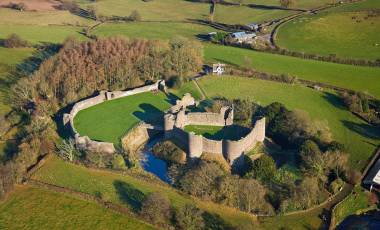
This medieval castle dominates the centre of the town of Caerphilly in south Wales. It is the largest castle in Wales and the second largest in Britain after Windsor Castle. Built mainly between 1268 and 1271, it is an early example of a concentric castle with extensive water defenses.
The Ffestiniog Railway is a narrow gauge heritage railway, located in Gwynedd. It is a major tourist attraction located mainly within the Snowdonia National Park. The railway is about 131?2 miles long and runs from the harbour at Porthmadog to the slate mining town of Blaenau Ffestiniog. The line travels through mountainous scenery and is single track with passing places.
Wales' most spectacular seaside golf course, Nefyn, on the blustery Llyn Peninsula, is a rare treat. With far-reaching views from every hole and the Ty Coch Inn, on Porthdinllaen beach, just a short hop away, you'll have trouble concentrating on that crucial putt.
Often described as "the town of books", Hay-on-Wye is a small market town in Powys, Wales. The town lies on the east bank of the River Wye and is within the Brecon Beacons National Park, just north of the Black Mountains. The town has at least 41 separate bookshops (mostly second-hand / antiquarian / collectors) and is probably best known as the location of a prestigious annual Hay Festival.
The Isle of Anglesey is an island county off the northwest coast of Wales, with a predominantly Welsh-speaking population. The island is known for its spectacular lighthouses. The Skerries Lighthouse can be found at the end of a low piece of submerged land, North-East of Holyhead and the lighthouse at South Stack (Ynys Lawd) near Holyhead.
At the western end of the Gower Peninsula, the village of Rhossil is a gateway for walkers and beach lovers and lies above the dazzling sandy crescent of Rhossili Bay. The terrain west of the village is largely owned by the National Trust. Worm's Head is a tiny tidal ideal at the very tip of Rhossili Bay.
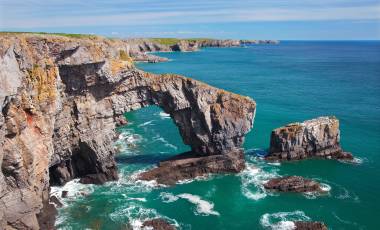
The Pembrokeshire Coast National Park, one of Britain's breathing spaces, takes in about a third of the county including the entire coastal strip, the upper reaches of the Daugleddau (two swords) and the Preseli's. Its the only National Park that is almost all coastal. This is Britain's only truly coastal National Park. It's a spectacular landscape of rugged cliffs, sandy beaches, wooded estuaries and wild inland hills, and a place of sanctuary for wildlife.
Situated on the Welsh bank of the River Wye in Monmouthshire - which forms the border between Monmouthshire in Wales and Gloucestershire in England - it was only the second Cistercian foundation in Britain, and the first in Wales. It is one of the most spectacular ruins in the country and inspired the William Wordsworth poem "Lines Composed a Few Miles above Tintern Abbey."
Cardigan Bay is a large inlet of the Irish Sea, indenting the west coast of Wales. Cardigan Bay is known for its numerous beaches and unique marine life (such as dolphins). From the Ceredigion Coast Path it is possible to observe Bottlenose Dolphins and Atlantic Grey Seals.
Conwy Castle is a castle in Conwy, on the north coast of Wales. It was built between 1283 and 1289 during King Edward I's second campaign in North Wales. It is a dark stoned fortress perched above the Conwy Estuary.
Wales is known as the land of song, even more so after a slew of recent TV programs and the worldwide success of choirs such as Only Men Aloud, whose founder and music director Tim Rhys Evans is running a campaign to find the next generation of male singers (aged 14 to 19) in the south Wales valleys. Most of the choirs in Wales encourage visitors to come along and listen during their rehearsals.
Llanfairpwll railway station is a station on the North Wales Coast Line on Anglesey. It serves the village of Llanfairpwllgwyngyll. The station is known for its longer name, Llanfairpwllgwyngyll-gogerychwyrndrobwll-llantysilio-gogogoch. The name is one of the longest domain names in the world. The name translates as 'St Mary's church in the hollow of the white hazel near a rapid whirlpool and the church of St Tysilio of the red cave'.
|
|